Guide
Turn phone footage into a 3D tour of any room or building

Make a 3D tour of a hotel, flat, shop or office from ordinary phone video or photos, so people can see the real space before they visit or book.

What you need
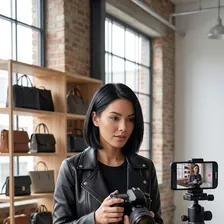
- A recent smartphone (one with a depth sensor helps, but is not required)
- A 3D capture app that rebuilds rooms from video or photos (look for “Gaussian splatting” or “photogrammetry”; several have free tiers)
- Any AI chat assistant, for the plan and the hotspot texts
- The owner’s permission, and an hour per few rooms with nobody in them
Steps
Plan the walk with AI
Paste the full prompt below into an AI chat assistant and fill in the brackets. You get a route, a capture checklist per room and draft hotspot texts.
Prepare each space
Switch on every light, open or close all curtains the same way, remove personal items and anything with names or documents. Mirrors and glass confuse 3D apps — angle the camera away from them or cover small mirrors.
Capture slowly, in loops
Walk around the room slowly with the phone at chest height, then do a second loop lower and a third higher, always pointing into the room. Overlap is everything: never turn quickly. With photos instead of video, take many overlapping shots from every angle.
ExampleOne room: three slow loops, about two minutes in total; doorway pass to the corridor at the end so rooms connect.
Let the app rebuild it
Upload or process the capture in the app. Check the result for holes, blurry floors or floating blobs; recapture only the weak spots rather than the whole room.
Clean and connect
Crop floating blobs and the space outside the walls, set a good starting view, and link rooms with hotspots so a visitor can move from the lobby to a room.
Write honest hotspot texts
Use the hotspot part of the prompt. Keep each text short and true: what the guest sees there and one useful fact. Never describe something the space does not have.
Publish and test on a phone
Share the tour link or embed it on the booking or listing page, and open it on a mid-range phone on mobile data. If it loads slowly, offer a short narrated video walkthrough next to it — an AI video tool can add voice-over and subtitles.
The full prompt
Copy it into any AI chat assistant and fill in the brackets.
You are a property-marketing assistant who plans 3D capture tours for small businesses.

Property: [type — e.g. small city hotel / flat / shop]
Spaces to include: [list — e.g. entrance, lobby, breakfast room, 3 room types, courtyard]
Who will view the tour: [e.g. couples booking a weekend, business travellers]
What visitors ask most before booking: [e.g. how big the room is, view from the window, quiet or not]
Things that must NOT appear: [e.g. staff areas, guests, documents, personal photos]

Do four things, in this order:
1. ROUTE: propose the order of spaces so the tour feels like a natural walk from the street door. Mark where one space should connect to the next.
2. CAPTURE CHECKLIST: for each space, list what to prepare (lights, curtains, items to remove, mirrors or glass to avoid) and how to walk it with a phone: three slow loops — chest height, low, high — always facing into the room, about 2 minutes per room. Flag anything likely to cause problems (reflections, very dark corners, moving water, screens).
3. HOTSPOTS: for each space, write 2–3 hotspot texts of at most 20 words each. Only describe what a visitor will actually see in that space; answer the questions visitors ask most. No superlatives you cannot prove.
4. CHECK: list every claim in your hotspot texts and mark which ones I must verify on site before publishing (sizes, distances, views, noise).

Ask me up to five questions first if anything above is missing. Use plain English.
What you end up with
A walkable 3D tour of the real space, honest hotspot texts and a capture checklist you can reuse for the next property.
Common mistakes
- Filming with people in the frame — blur or recapture; never publish guests or staff without consent.
- Turning or walking fast — the app loses track and leaves holes.
- Editing the tour to show something the space does not have.
- Publishing without testing on a phone on mobile data.
Tools for this guide
 Tool
ToolFliki
Turns text into videos with AI voices.
From €24 per user per month (Standard, monthly billing, no commitment) (source, checked 2026-10-04)
Price, free plan & terms →